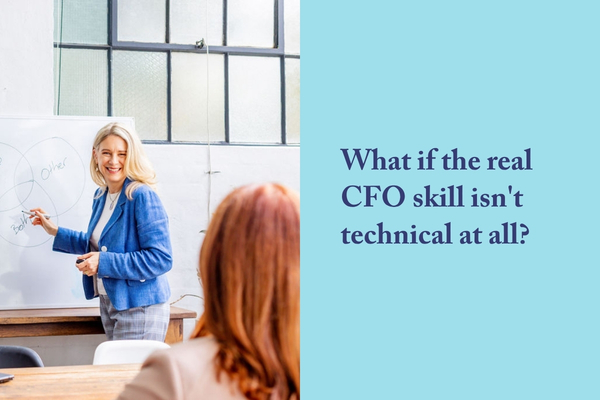
What if the real CFO skill isn't technical at all?
There is a moment many CFOs know well.
You are in the boardroom. The narrative being presented is, to be honest, a little rosier than the numbers support. The momentum in the room is forward. Nobody wants to be the one who slows it down.
And yet.
That is exactly your job.
Board director Barbara Kux, speaking to McKinsey, put it plainly: at times the CEO defaults to presenting only the positives and it falls to the CFO to play back a more balanced story. "It takes a great deal of self-assurance," she noted, "to walk into a boardroom and say, 'by the way, we are losing market share here.'"
Self-assurance. Not technical capability. Not data mastery. Self-assurance.
That word stopped me.
Because it points to something most leadership conversations about the CFO-CEO relationship miss entirely. The governance literature frames it as a question of structure. The strategy literature frames it as a question of priority alignment. What almost nobody is writing about is what it takes personally for a CFO to inhabit that role well - day after day, under pressure, in relationship with someone who is often more senior, more visible, and more naturally in the authority position.
This is where the paradox we've been exploring lands in its most demanding form.
To be effective in this partnership, you must be both independent and a genuine partner. Willing to challenge and equally willing to support. Simultaneously.
The CFO who can see the numbers clearly, who refuses to let optimism blur the picture, is not holding the organisation back. They are giving it the most honest possible foundation from which to move forward. This is the Stockdale paradox in action as I explored in an earlier newsletter: confronting the brutal facts of current reality, while never losing faith in the eventual outcome.
Anchored in reality is not the same as tethered to the status quo.
The hard part is not knowing that. The hard part is living it: in the room, in the moment, when the pressure is on.
The CFOs I work with who navigate this relationship best have a few things in common. They know where their own edges are - where they tend to over-defer, and where they dig in too hard. They have built a relationship of deep trust with the CEO and have developed the language to challenge without confronting, to hold a position without closing down the conversation. And they have learned to read the relational temperature in a room, not just the financial one.
None of that comes from a finance qualification.
So here are my questions for you this week:
In your CEO relationship, where do you find it hardest to hold your ground?
And is that a strategic gap - or a presence one?
Because the answer to that question changes everything about where you focus your energy.
If this is territory you want to explore, I have a small number of coaching spaces available this quarter. I would love to talk.
With love
Sue