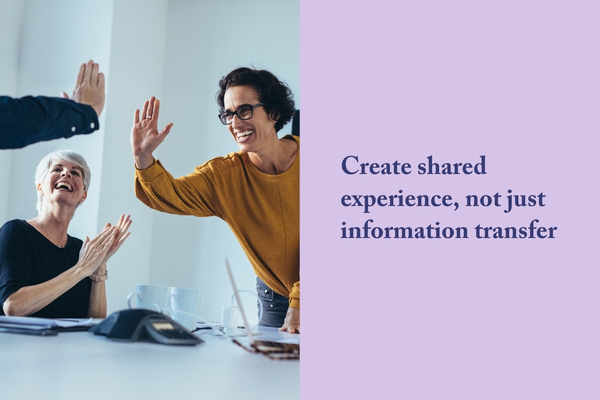
Create shared experience, not just information transfer
For the past few weeks, our living room has been an emotional rollercoaster.
Like many Australians, I and my family followed multiple teams in the World Cup - the Socceroos because this is our home, and England because that was where my husband and I were raised. Phones buzzed with family in the UK and the US, all of us watching the same match on different continents. Heartbreak when Australia went out on penalties. Hope maintained around England. And then heartbreak again, watching Argentina claw back the semi-final in the last ten minutes.
We felt every bit of it. Genuinely swept up, oceans apart from each other and from the stadium, but somehow together in the feeling.
And yet.
There is a particular thing that happens only inside the stadium, that no living room, no group chat, no shared moment across time zones can quite replicate: thousands of strangers, arms around each other, roaring as one when the ball hits the net.
Sociologists have a name for it: collective effervescence. Émile Durkheim coined the term to describe what happens when a group physically comes together and, for a moment, shares the same feeling - and that shared experience unifies the group. He wrote about it more than a hundred years ago, watching tribal rituals. Turns out he could just as easily have been watching a World Cup final!
Our WhatsApp threads gave us connection. But they didn't give us collective effervescence - that requires bodies in one space together. Proximity isn't a detail. It's the mechanism.
Which makes it worth asking: when did your team last feel anything like that?
Most workplaces have gone in the opposite direction. We've optimised gathering into oblivion. Town halls become status updates. Celebrations become a Slack emoji and a gift card. We've treated time spent simply being together, in person, as a cost to be minimised.
Leaders who understand this aren't running fewer meetings and calling it efficiency - they're creating fewer, more meaningful moments where people genuinely, physically come together: a real celebration when the deal closes, a room where a hard year gets properly acknowledged, an all-hands that feels like something.
So here's what I'm asking myself this week, and what I'll ask you:
Where in your leadership are you creating moments of shared, embodied experience - not just information transfer?
And what would it take to build more of them into how your team works?
This is the first of several things I want to explore with you over coming weeks about the human skills we need to bring to leadership in an era of AI.
Let me know when you last felt the energy of collective effervescence!
With love
Sue